
 The Power of Solo Play
If you’ve ever watched a preschooler go full-blown mom-mode on a pretend baby, or build a block tower only to gleefully knock it down moments later, you’ve witnessed the magic of independent play. Independent play isn’t solely about keeping kids busy in order to give a parent, caregiver, or daycare teacher time to focus on other things–though it’s a nice bonus! Independent play is actually a foundational piece of early childhood education that nurtures creativity, problem-solving, and self-confidence.
For parents looking for quiet at-home activities, childcare providers cultivating engaging learning centers, or early childhood educators preparing a classroom, fostering an environment of independent play is important.
We are great at both structured learning and independent play here at Lily Pad Childcare–and both serve an important role! Schedule a tour today to check out our classroom centers and lesson plans and see how we can help your child learn and grow.
What Is Independent Play?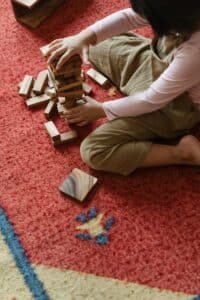
Independent play is defined by children engage in activities on their own, without direct adult involvement. An important note is that this does not at all mean the children are isolated or abandoned. This means instead that children are given the space to explore their interests, make decisions, and manage their frustrations within their play all with an adult nearby should they require assistance. This is a key life skill as they develop and embark on much more challenging endeavors like learning to cook, addressing relational differences, and eventually start their own home.
According to Zero to Three, independent play helps develop focus, perseverance, and emotional resilience. It allows children to move at their own pace, experiment, and problem-solve creatively. Early childhood education lays the foundation for this growth, and it is a foundation that is built on for a lifetime–so it has got to be strong! Call today to schedule a tour here at Lily Pad Childcare and see the power of learning through play for yourself!
Simple Independent Play Activities for Preschoolers
The American Academy of Pediatrics has found that play is vital for healthy brain development and social-emotional growth. So, looking for ways to encourage independent play at your childcare center or daycare? For your home or your the home of your child’s caregiver? These activities set the stage for good, imaginative, and independent fun:
– Building and Construction Zones
Choosing open-ended toys like blocks, magnetic tiles, or even recycled boxes can give kids endless opportunities to buildwhatever their imagination can cultivate.
– Pretend Play Stations
Role play and storytelling are great for independent play and can spark hours of entertainment. Things like a pretend kitchen, doctor’s kit, or dollhouse are excellent tools to have at-the-ready.
Here at Lily Pad Childcare we have multiple role-playing toys and activities available for our little learners. Call today to schedule a visit and check us out!

– Sensory Bins
This can be as simple as filling bins with rice, play dough, sand (kinetic sand is great!), or water beads and supplying spoons, scoops, cups, or tiny figurines. Watch your preschoolers creativity play explode!
Pro tip: If mess is a major concern or stressor, lay a reusable vinyl playmat underneath your child’s play area, or even move them to a sensory bin or table outside!
– Art and Creativity Corners
Crayons, paper, stickers, and stencils—the perfect concoction for self-made masterpieces! The National Association for the Education of Young Children asserts that open-ended art encourages self-expression.
– Puzzle Play
Offer puzzles with varying difficulty and a variety of themes. Solving a puzzle solo will help build their perseverance, confidence, and make them immensely satisfied with themselves.
Looking for some inspiration? Come see not only our puzzles, but our various independent play centers here at Lily Pad Childcare!
– Nature Exploration
Indoors or outdoors, give them magnifying glasses, leaves, and rocks to explore nature at their own pace (Harvard Graduate School of Education, 2022). Creating or printing off scavenger hunts will challenge their observation and recall skills, as well.
Pro tip: Keep some printed scavenger hunts and writing utensils on hand for impromptu nature walks or park outings. Here are some examples here: Scavenger Hunts for Littles.
How to Support Without Taking Over

It can be hard to watch play in action at times–especially if a child begins to struggle with a toy or guilt of leaving them to play threatens to creep in. Whether as a parent, caregiver, or daycare or childcare educator, you do not need to leave these little ones fully to their own devices, though. While the goal is independence, children need gentle scaffolding to build confidence:
- Set up a safe, stimulating space where children can explore freely.
- Observe, don’t direct. Sit nearby with a smile or occasional words of encouragement.
- Rotate a variety of toys to keep interest in what is provided.
- Celebrate effort over the results. Praising their creativity with comments such as “I love your colorful drawing!” helps build their pride.
We are absolutely ready to be your child’s biggest cheerleader–next to you, of course! Here at Lily Pad Childcare we know that celebrating the growth of our students plays a pivotal role in their development. Come visit us and meet our lovely early childhood educators and see the classes your little one can look forward to.
 The Joy of Solo Play
Remember, independent play isn’t about “leaving kids alone” but rather, equipping them with the confidence they need to explore, imagine, and create in their own time. Whether at home or within a childcare or daycare setting, these quiet moments of discovery foster a lifetime of learning.
Here at Lily Pad Childcare we are here to support children through every stage of play–from learning to sit up to running around on the playground! Schedule a tour today; we would love to share our lesson plans, outdoor areas and give you the opportunity to meet our lovely teachers!